The Unsolved 1951 Murder of Ernest “Slack” Maher
In July 1951, bushland near Jesmond became the scene of a murder for which no one was ever convicted.
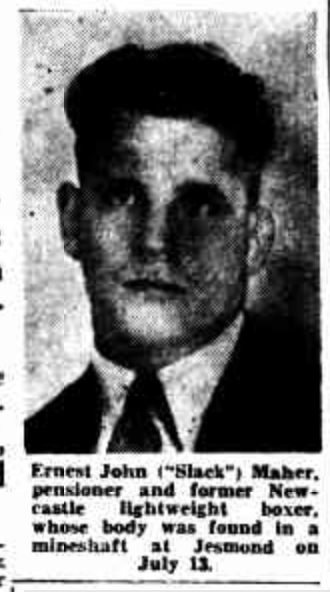
The victim was 48-year-old Ernest John Maher, better known locally as “Slack”. His body was discovered at the bottom of an abandoned mine shaft, two days after he had left his home for an illegal two-up game.
Maher’s brother was charged with the killing and committed to stand trial. However, after hearing conflicting evidence and an alibi supported by numerous witnesses, a jury found him not guilty.
More than 70 years later, the identity of Ernest Maher’s killer remains unknown.
Hollywood: Jesmond’s bush settlement
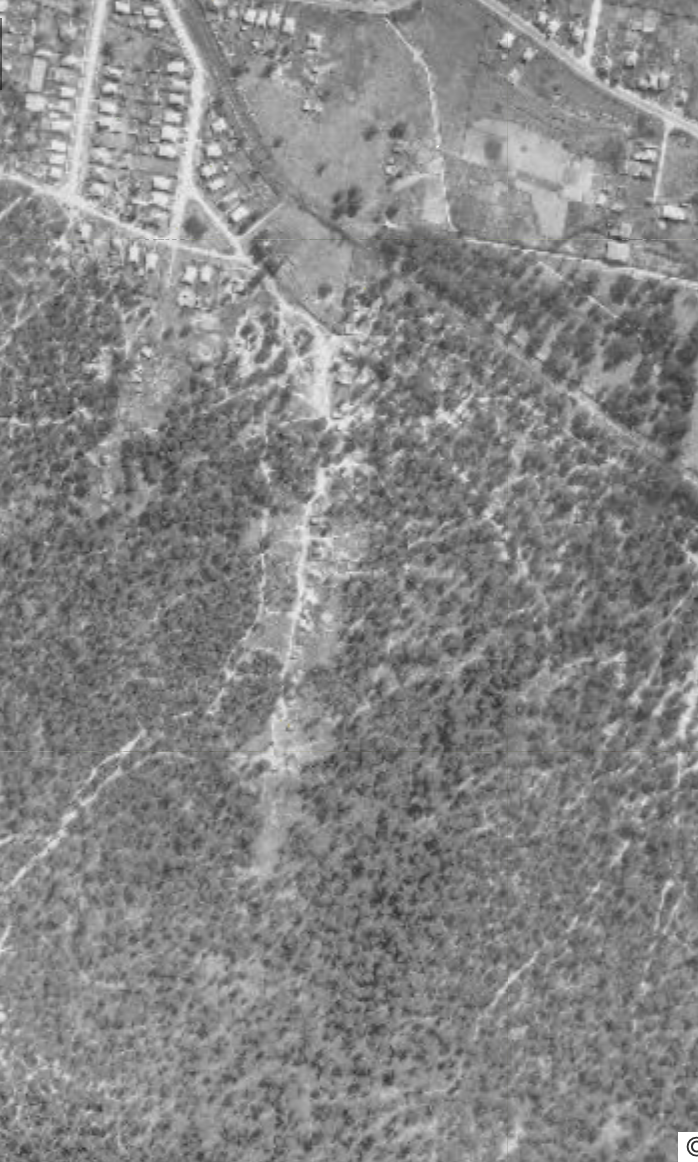
1944 Aerial View of Hollywood - NSW Government Historical Imagery
During the Depression and postwar years, an unofficial settlement known as Hollywood stood in the bush outside Jesmond.
Families lived in makeshift homes built on Crown land, creating a close-knit community on the edge of Newcastle’s suburban development. Contemporary newspapers regularly referred to Hollywood as a shanty town or reserve.
Further into the surrounding bush was a two-up school.
Despite the name, a two-up school was not an educational institution. It was a place where people gathered to play two-up, a gambling game in which coins were tossed into the air and bets placed on how they would land.
Two-up was generally illegal outside limited circumstances, so games were often conducted away from public view in bushland, sheds or other secluded locations.
The Jesmond game attracted local residents and visitors, including Ernest Maher.
Who was Ernest “Slack” Maher?
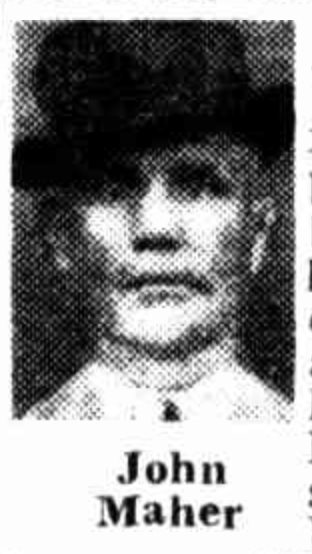
Ernest John Maher was born around 1903 and had boxed as a lightweight during the 1920s.
By 1951, he was living at Hollywood and receiving an invalid pension. Newspaper accounts described him as having disabilities attributed to his boxing career. Police evidence reported during the inquest said that he dragged one foot while walking.
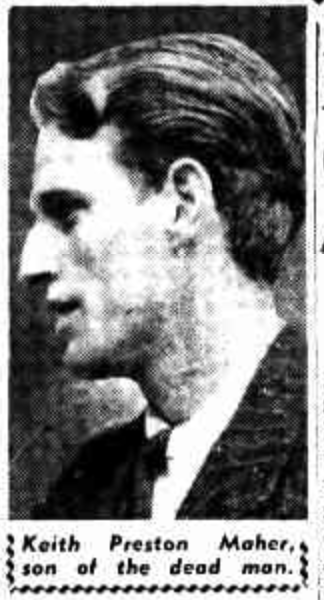
His son, Keith Maher, also testified that his father could be difficult to understand when speaking, particularly when excited.
Maher was reportedly a familiar figure at the local two-up games. According to Keith, he sometimes lent money to people who had exhausted their funds while gambling.
Keith told the inquest that his father kept lists recording the money he was owed. He believed Maher may have charged interest of between two and four shillings for every pound lent.
This evidence suggested that Maher may have been carrying money and dealing with debts around the two-up school. However, it does not establish that money lending was the reason he was killed.
Maher disappears
On Wednesday, 11 July 1951, Maher left his home at approximately 3 pm.
He was seen walking in the direction of an old tramway cutting and the bushland where the two-up game was held.
Early newspaper reports said relatives believed he had approximately £30 in his possession. The precise amount he was carrying has not been firmly established.
Maher did not return home that evening.
His son began making inquiries and eventually reported him missing. Police and civilian volunteers searched the bush between Hollywood and the site of the two-up game.
Searchers inspected waterholes, tracks and abandoned mine workings scattered throughout the area.
Blood on the tramway
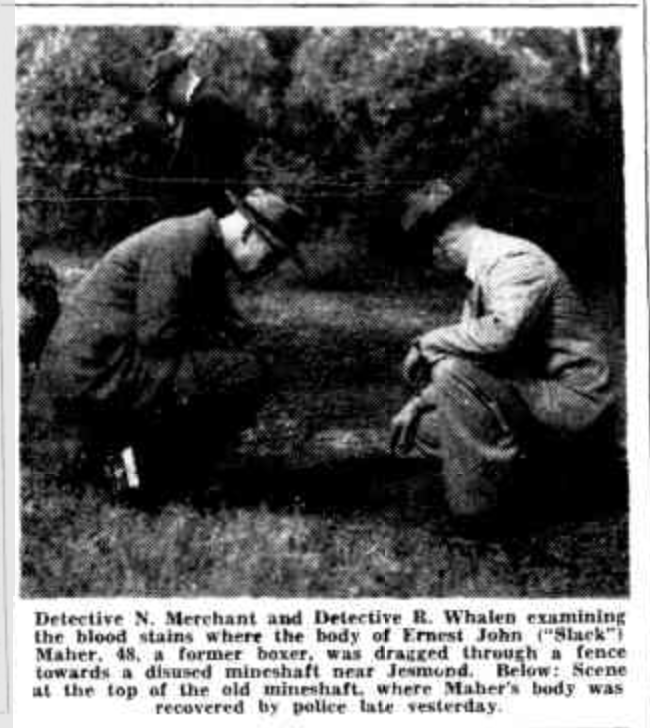
On Friday, 13 July, searchers found bloodstains along an old, muddy tramway track.
Newspapers reported that the spots were widely separated in places, with some as much as 100 yards apart.
The trail led further into the bush towards an abandoned mine ventilation shaft. Nearby, investigators reportedly found disturbed soil, damaged vegetation and signs that something may have been dragged across the ground.
At the bottom of the shaft, police discovered Maher’s body.
He had suffered a fatal gunshot wound to the back of his head. Contemporary reports also described a second bullet wound to his right arm.
The location of the body and the surrounding disturbance indicated that Maher had been moved to the shaft after being shot, although the surviving newspaper evidence does not establish every detail of how this occurred.
The investigation turns to Maher’s brother
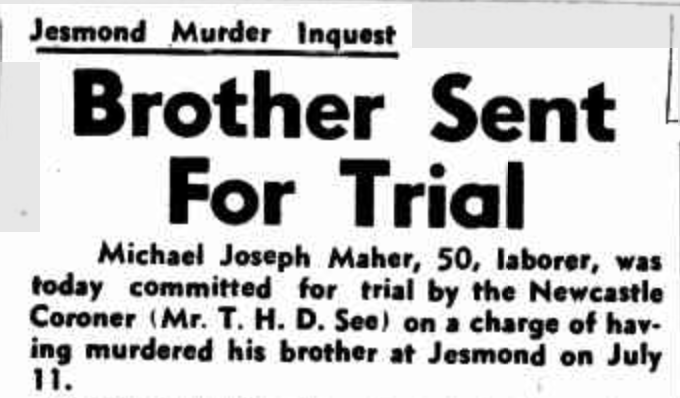
Police soon focused their investigation on Ernest’s older brother, Michael Joseph Maher, commonly known as Mick.
Michael was taken into custody and accused of murdering Ernest following an argument over money.
The coronial inquest began in Newcastle in August 1951. It continued for approximately four days, heard evidence from 23 witnesses and considered 43 exhibits.
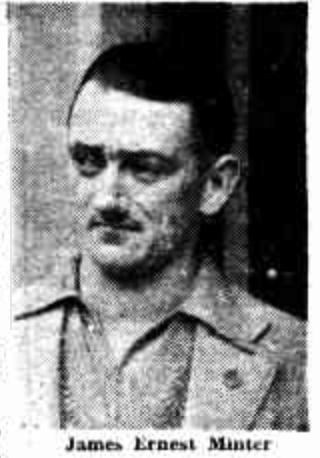
The most serious evidence against Michael came from James Ernest Minter.
Minter claimed that he had seen the brothers arguing in the bush. According to newspaper accounts of his evidence, he said that Michael raised a rifle to his shoulder and that he then heard two shots.
If accepted, this placed Michael at the scene and directly connected him with the shooting.
However, Minter’s account was challenged during the proceedings.
Problems with the evidence
The case against Michael Maher was far from straightforward.
Questions were raised about distances, visibility and whether conversations could have been clearly heard from the positions described by witnesses.
Ernest’s son told the inquest that his father was often difficult to understand, especially when excited. This evidence was relevant because parts of Minter’s account relied on him hearing or interpreting an argument from some distance away.
Another witness disputed part of a statement attributed to him during the police investigation. Evidence was also given that Ernest and Michael had generally been on friendly terms.
Michael denied killing his brother.
The defence argued that he had been elsewhere when the shooting occurred. Witnesses said that Michael had been collecting building materials and working on a house around the estimated time of Ernest’s death.
Despite the disputed evidence, Newcastle Coroner T. H. D. See found that Ernest’s wounds had been deliberately inflicted by Michael and committed him to stand trial.
A coroner’s decision to commit a person for trial is not a finding of criminal guilt. That question remained for a jury to decide.
The murder trial
Michael Maher’s trial was held in Sydney’s Central Criminal Court in November 1951.
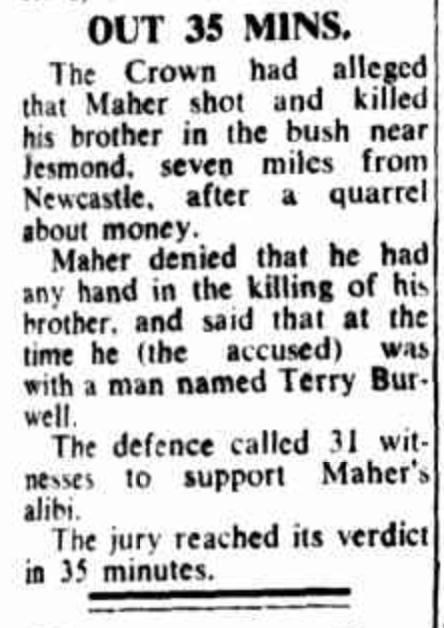
The Crown alleged that Michael had shot his brother after an argument about money.
Michael maintained that he had played no part in the killing and said he had been with another man at the relevant time.
The defence called 31 witnesses in support of his alibi.
After a six-day trial, the jury retired to consider its verdict. Contemporary reports differ slightly on whether the deliberation lasted 35 or 40 minutes, but agree that the decision came quickly.
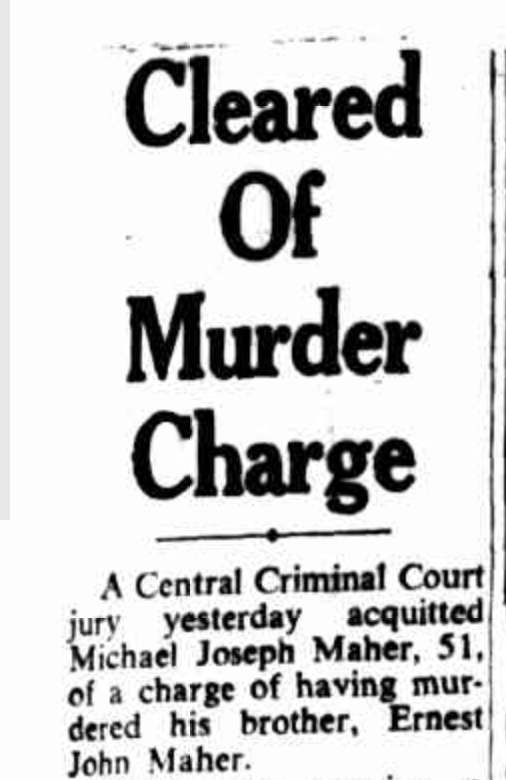
The jury returned a verdict of not guilty.
Michael Maher was acquitted and released.
Who killed Ernest Maher?
Michael Maher’s acquittal meant that the case ended without anyone being convicted of Ernest’s murder.
The surviving reports raise several possibilities but provide no conclusive answer.
Maher was associated with an illegal gambling game, reportedly carried money and lent funds to other gamblers. These circumstances may have exposed him to disputes, but they do not identify his killer or prove a motive.
The prosecution believed that an argument between the brothers led to the shooting. The jury, however, was not satisfied beyond reasonable doubt that Michael was responsible.
No reliable evidence reviewed for this article establishes that another person was subsequently charged or convicted.
The central question therefore remains unanswered:
Who killed Ernest “Slack” Maher and left his body in an abandoned mine shaft in the Jesmond bush?
Timeline
Wednesday, 11 July 1951
Ernest Maher leaves his home at Hollywood at approximately 3 pm and walks towards the two-up game.
Thursday, 12 July 1951
Relatives and police begin searching for him.
Friday, 13 July 1951
Bloodstains are found along an old tramway track. Maher’s body is discovered in an abandoned mine ventilation shaft.
August 1951
A coronial inquest is held in Newcastle. Michael Maher is committed to stand trial.
November 1951
Michael Maher is tried at the Central Criminal Court and found not guilty.
Additional Reading
Lachlan Wetherall has written a great article on the history of Hollywood, including details on Maher’s murder. You can view it here: https://lachlanwetherall.com/then-and-now/hollywood/
References
Baker Archaeology. (2016, November). Newcastle Inner City Bypass: Rankin Park to Jesmond: Technical Paper 9, Non-Aboriginal Heritage Assessment (Appendix N). Roads and Maritime Services.
No title. (1951, July 20). The Newcastle Sun, p. 3.
Revolver may be murder clue. (1951, July 15). The Daily Telegraph, p. 7.
Wetherall, L. (2025, September 20). "Hollywood".A Bit of This, A Bit of That.
Witness tells of shots in bush; death of ex-boxer. (1951, August 12). Truth, p. 7.
Cleared of murder charge. (1951, November 25). The Sunday Herald, p. 3.
Jesmond murder probed by coroner; brother in custody. (1951, August 8). The Newcastle Sun, p. 1.
Man's dramatic inquest story: Heard row, then shots. (1951, August 9). The Newcastle Sun, p. 2.
Jesmond murder inquest: Brother sent for trial. (1951, August 14). The Newcastle Sun, p. 1.
Maher not guilty. (1951, November 26). The Newcastle Sun, p. 1.